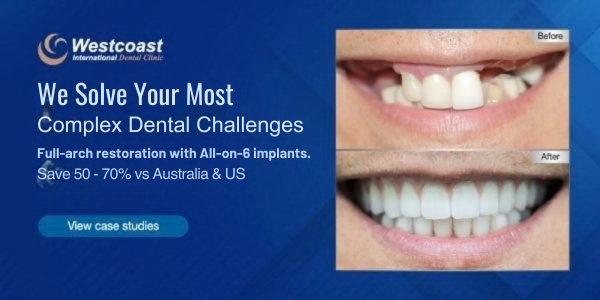
All-on-4 vs All-on-6: Why Implant spread and posterior support matter
All-on-4 and All-on-6 are not two prices for the same smile. They are two different bridges. The question is which design still chews, cleans, and holds up honestly five and ten years from now.
I will be direct. When the anatomy allows it, a six-implant design that is spread along the arch – with real support at the back – is the better engineering. That is not a sales preference. It is what the biomechanics and the published research say.
At Westcoast, All-on-4 is not presented as an equal but cheaper alternative. Our All-on-4 uses four dental implants supporting an 8-unit fixed restoration without a distal cantilever. Our All-on-6 builds a 14-unit full-arch restoration on six well-distributed implants, with a milled titanium bar on the upper arch and individual zirconia crowns. For international patients, this treatment is planned over two trips, with the final plan confirmed after examination and imaging.
1. Comparing All-on-4 and All-on-6 Dental Implants
| All-on-4 at Westcoast | All-on-6 at Westcoast | |
|---|---|---|
| Implants per arch | Four implants | Six implants, spread along the arch |
| Restoration | 8-unit fixed restoration (short span) | 14-unit full-arch restoration |
| Rear of the smile | Corners left open – visible in the plan | Filled with posterior support |
| Distal cantilever | None in our design | Posterior implants provide direct support – no hanging back end |
| Upper framework | No milled bar | Milled titanium bar; individual zirconia crowns |
| Main consideration | Can four implants safely support the shortened restoration? | Can six spread implants build a broader, more supported foundation? |
| Treatment planning | Examination, imaging and restorative planning | Examination, imaging and restorative planning |
| International treatment | Two trips | Two trips |
| When used | Bone only allows four honest sites | Default when anatomy supports a spread design |
| Fees | Personalised quotation after assessment | Personalised quotation after assessment |
2. Why I Prefer Six Well-Distributed Implants When Possible
Additional implants only improve a design when they can be placed in positions that are actually useful. An extra fixture clustered near the front of the arch adds little. The advantage comes from spreading those implants further along the jaw, so the supporting foundation reaches toward the back of the smile.
- Wider support across the arch: A wider implant distribution lets us extend the foundation from the front toward the back of the jaw. This becomes particularly important when the restorative plan requires posterior chewing support.
- More supporting points for the restoration: Chewing forces pass through the restoration and into the implants below. When useful implant positions are available across a wider part of the arch, the restoration can be supported across a broader base. The objective is not simply to increase the implant count – it is to improve the distribution of support.
- Better posterior anchorage: Where implants can be positioned further toward the back of the jaw, more of the restoration can be directly supported. This avoids the unsupported bridge extension – the cantilever – that is often associated with complications in All-on-4 treatment.
- More restorative flexibility: I plan full-arch cases around the restoration we want to build. Useful implant positions further across the arch give the surgical, restorative and laboratory teams greater flexibility when planning posterior support, the occlusion and the final prosthesis.
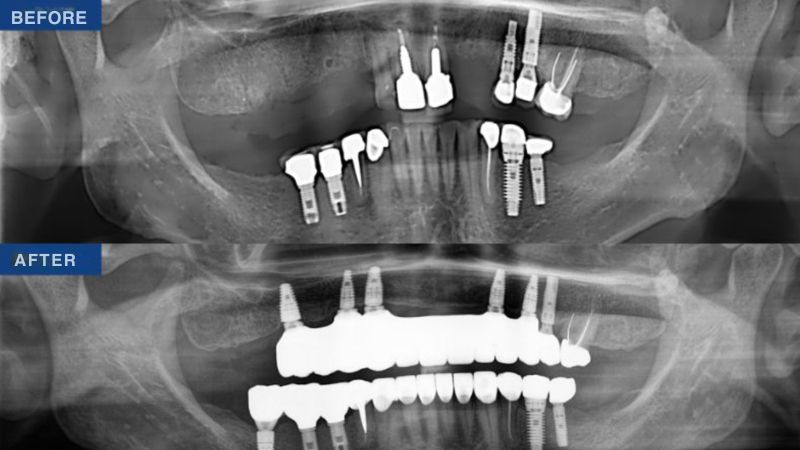
3. Scientific Evidence Behind Full-Arch Implant Designs
Dr. Dan Holtzclaw – a board-certified periodontist who has published the principal modern work on immediately loaded pterygoid implants, made the engineering problem explicit in print.
In his 2018 study he introduced a protocol designed to eliminate prosthetic cantilevers, which were often associated with problems that arose from the All-on-4 protocol (Holtzclaw, Journal of Implant and Advanced Clinical Dentistry, 2018).
In 2023, writing about the PATZI sequence, he identified three goals of pterygoid-first planning: cantilever elimination, maximising anterior-posterior spread, and increasing composite torque value (Holtzclaw, Implant Practice US, 2023).
That is the argument in one line. All-on-4 often leaves the last teeth hanging past the last implant, like a diving board. That cantilever raises stress on the terminal bone, loosens screws and breaks prosthetics.
Finite-element modelling of All-on-4 has confirmed the same pattern: longer cantilevers raise stress at the implant-bone interface (Ozan and Kurtulmus-Yilmaz, International Journal of Oral and Maxillofacial Implants, 2018).
Six implants, placed so the chewing end of the bridge actually sits on bone, remove that diving board. That is the design I want for you when the scan allows it.
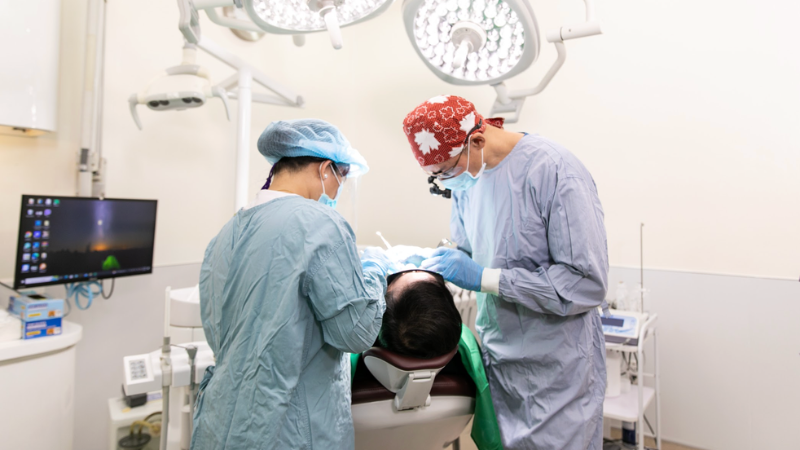
4. The Westcoast Standard for Building Full-Arch Restorations
At Westcoast, All-on-6 is not “two extra implants sprinkled in the front.” It is a spread: four implants in useful anterior and mid-arch bone, and posterior support that reaches the back of the smile. On the upper jaw, that posterior support is typically a pterygoid implant on each side, placed in the dense pterygomaxillary bone behind the sinus.
The final restoration is a 14-unit full-arch bridge built on a milled titanium bar, with individual zirconia crowns seated on it. The prosthesis can be removed by the clinical team for maintenance; it cannot be taken out at home. The lower All-on-6 uses the same principle: a 14-unit bridge on six spread implants, without a bar.
All-on-4 still has a place when four implants are all the bone will honestly support, when I use it, I do not compensate for limited bone by extending the bridge past the last implant. The Westcoast All-on-4 is an 8-unit short-span restoration. No cantilever. The visible trade-off is open space at the corners of the smile. I would rather patients see that in the plan than discover it after the teeth are in.
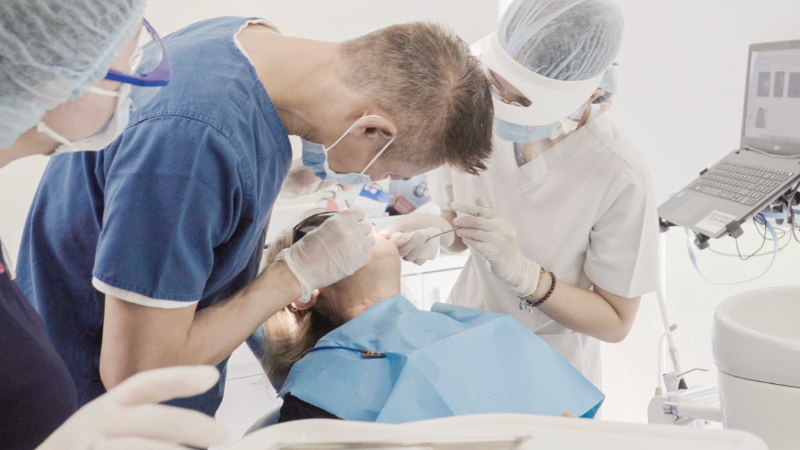
5. When Pterygoid Implants May Avoid a Staged Sinus Lift
This is the section most clinic pages skip or dress up as a package name. It is worth explaining clearly.
In a patient with a resorbed upper jaw, conventional posterior implant placement often runs out of bone before reaching the molar region. The classic alternative is a sinus lift and bone graft, followed by several months of healing, then posterior implants on a separate trip. That is a third journey, extra surgery and months without a finished posterior arch.
A pterygoid implant takes a different route. It uses bone that already exists – in the pterygomaxillary complex, behind and below the sinus. There is no graft, no sinus membrane to risk tearing, and the posterior support is placed in the same surgical session as the rest of the arch.
| Sinus Lift + Posterior Implants | Pterygoid Implants | |
|---|---|---|
| Bone used | Grafted bone (must mature before loading) | Dense native bone behind the sinus |
| Extra surgery | Sinus lift and graft procedure | No graft, no sinus membrane |
| Trips required | Often adds a third trip because the graft must heal before posterior implant placement. | Two trips (same visit as arch surgery) |
| Healing wait | Months before posterior implants can load | No additional graft healing period |
| A-P spread | Limited by sinus position | Dramatically increases A-P spread (Holtzclaw 2018) |
| Cantilever risk | Posterior gap may force a cantilever | Eliminated or minimised |
| Graft-related morbidity | Graft site plus sinus exposure | Avoided because no sinus graft is performed |
| Cost | Higher – extra surgery and trip | Lower overall |
A sinus lift does not automatically mean three trips. In selected cases, sinus elevation and implant placement may be performed at the same surgical stage when sufficient primary stability can be achieved. The exact sequence depends on the anatomy and surgical plan.
The cost difference is real, and it is not the main reason I prefer this approach. The main reason is engineering: pterygoid placement gives a wider anterior-posterior spread in the same surgical visit, without graft morbidity or an additional healing wait. A well-spread implant foundation can also create more favorable biomechanical conditions for immediate loading when adequate primary stability is achieved.
Published survival data for pterygoid implants
- 98.02% – Holtzclaw immediate-load series (based on 1,058 pterygoid implants).
- 94.87% – Mean survival rate according to a systematic review by Araujo et al. (2019), analyzing 1,893 implants.
- 92.5% – 10-year cumulative survival rate, as reported by Raouf & Chrcanovic (2024).
These are published figures from peer-reviewed sources, not Westcoast-specific marketing numbers.
Pterygoid placement is never guaranteed. In Dr. Andrew’s clinical experience, while anatomical suitability is frequently identified during 3D planning, final feasibility can only be confirmed clinically during surgery. If pterygoid placement is not viable on the day, the honest fallback is a shorter arch – not an unexpected sinus lift unless that pathway was already consented to beforehand. A shorter upper arch can leave visible space at the back of the smile, which we discuss openly prior to treatment.
6. When Westcoast Uses All-on-4
Our All-on-4 design uses four implants supporting an 8-unit fixed restoration without a distal cantilever. Some descriptions of All-on-4 involve a bridge that extends behind the most posterior supporting implant.
That is not the design we use here. Available bone is not distributed evenly throughout the jaw. Bone loss, bone density, the position of the maxillary sinus, nerve anatomy, previous implant treatment and the patient’s existing dental condition all affect where implants can be placed.
There are therefore cases where a four-implant design is the appropriate foundation for the planned shortened restoration. I do not choose All-on-4 because it uses fewer implants or because it can be positioned as a cheaper option. I choose the implant configuration according to the patient’s anatomy and the restoration that needs to be supported.
7. When Six Implants and Pterygoid Support Add Value
A six-implant design becomes most useful when the additional positions genuinely improve the supporting foundation. This is more likely when a patient has:
- A wider arch: Useful additional positions allow support over a greater distance.
- A need for greater posterior support: Particularly when the restorative design requires the back of the arch to function fully.
- Strong bite forces or parafunctional habits: Clenching and grinding increase mechanical demands; a broader foundation distributes those forces more effectively.
In the upper jaw, conventional posterior implant placement can sometimes be limited by bone resorption or the position of the maxillary sinus. In selected cases, I use a pterygoid implant to extend support further toward the back of the arch.
Pterygoid implants are not routinely required for every six-implant case. They are one of several surgical options considered after examination, imaging and restorative planning.
8. The Implant Systems We Use
I select the implant system at surgery from internationally recognised lines: Straumann, Implant Direct InterActive.
The fee does not change based on which system is chosen. Selection is made on the basis of available bone, connection type and what the case requires – not on branding. Ask for the system name to be documented in your clinical notes.
9. How I Decide Between All-on-4, All-on-6 or Another Configuration
The treatment plan cannot be made from the implant number alone. I evaluate the entire restorative situation, including:
- Available bone and its distribution throughout the arch
- Bone density
- The width and shape of the arch
- Safe and useful implant positions
- Posterior support requirements
- The planned restoration
- Bite forces, clenching and grinding
- Existing implants and previous implant failures
- Medical history, medications and smoking status
- Hygiene access and long-term maintenance requirements
CBCT imaging helps evaluate available bone and critical anatomical structures in three dimensions. But the scan is one part of the process. The surgical plan, restorative plan and laboratory design have to work together. The aim is to place the right implants in the right positions for the restoration being built.
10. Full-Arch Treatment Does Not Always Fit a Standard Formula
Some patients have previous implants, failed implants, significant bone loss or restorative requirements that do not fit neatly into a standard All-on-4 or All-on-6 configuration. In those situations, I plan the implant positions around the individual case rather than fitting the patient into a preset protocol.
11. Real Success Stories of Complex Implant Restorations at Westcoast
11.1 Full-mouth restoration with 11 implants
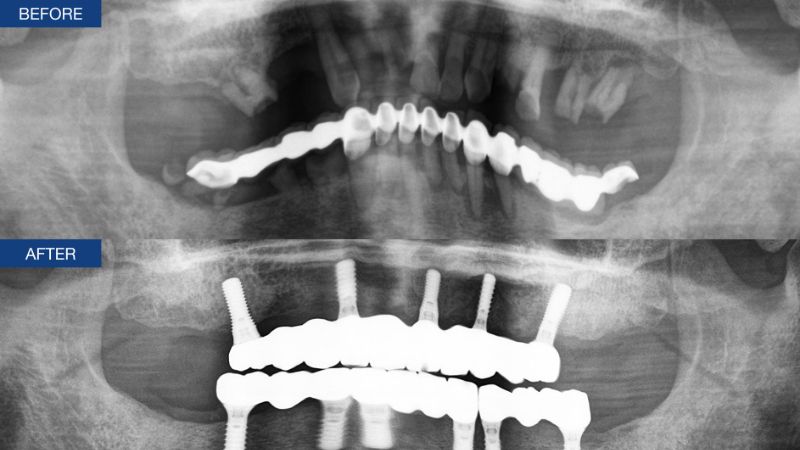
A Vietnamese-American man in his nineties had been through more than twenty years of failed dentistry. We extracted what could not be saved, placed five implants in the upper jaw and six in the lower, fitted temporaries and completed a full-mouth restoration. Age was not a reason to offer him a denture.
11.2 Fixing failed dental implants
A man in his sixties arrived with six implants from four different systems and a history of clinics that had turned him away. The task was not to add a bridge on a compromised foundation – it was to replace what was wrong and build a mouth that could be maintained.
These cases are examples of individualised implant treatment. They are not examples of a standard All-on-4 or All-on-6 protocol.
12. A Complete Guide to Planning Your Dental Implant Journey in Vietnam
12.1 What can you send before you fly?
- A recent panoramic X-ray or CBCT scan, if available
- Clear photographs of your teeth, bite and smile
- Details of your current dental concerns
- Information about previous implants or dentures
- Relevant medical history and current medications
- Information about smoking, diabetes, bone-modifying drugs or grinding
- Your preferred travel dates
This allows an initial remote review before you arrange travel. Your final treatment plan is confirmed after an in-person examination.
12.2 Trip 1 – Surgical stage (allow 7 to 10 days)
After examination and review of imaging, the team confirms the treatment plan. Implant surgery – extractions, placement and contouring is carried out in one session under IV sedation. During healing, the upper arch receives a fixed temporary bridge; the lower arch receives a removable partial denture. A fixed lower temporary can disturb healing implants.
12.3 Between trips – healing period (approximately 4 to 6 months)
The implants and surrounding tissues need time to integrate before the definitive restorative stage. Your treatment team will advise on the appropriate healing period for your individual case.
12.4 Trip 2 – Definitive restorative stage (allow 14 to 21 days)
Healing and implant stability are evaluated before the final prosthesis is completed. The fit, bite, appearance and hygiene access of the restoration are all adjusted during this visit. Allow the full window – particularly if the upper arch is on a milled titanium bar.
For patients who do not live near a facility that performs this work, two concentrated trips are often more time-efficient than a drawn-out local process spread across months. The surgical week and the restorative week are booked as blocks. You are not living in a waiting room between appointments.
Read More: 3 Steps to Come Here
13. Comprehensive Dental Guarantees and Long-Term Maintenance Policies
Full-arch implant treatment requires ongoing care and maintenance. Westcoast has an existing written dental guarantee with terms and maintenance requirements applying to eligible treatment.
| Component | Guarantee period |
|---|---|
| Implant fixture | 10 years |
| Crown, abutment and fixed restorations | 5 years |
| Composite restorations | 3 years |
| Removable prosthetics | 5 years |
| Unexpected surgical / prosthetic issues | Assessed according to the written guarantee and clinical circumstances |
Review the current policy directly: Read the Westcoast Dental Guarantee →
14. All-on-4 vs. All-on-6: Which One Should You Choose?
You do not need to choose an implant number before your examination. When anatomy supports useful, well-distributed positions, I prefer a broader six-implant foundation that reaches posterior bone. When it does not, Westcoast may use an 8-unit All-on-4, pterygoid support or another individualised full-arch plan. The final choice depends on your anatomy and the restoration that needs to be supported.
– Dr. Andrew H.F. Tsang, Clinical Director
15. Frequently Asked Questions About Full-Arch Dental Implants
15.1 Why not just do a sinus lift and keep four implants?
A staged sinus lift with delayed posterior implant placement often adds a third trip because the graft must heal before implant placement. In selected cases, sinus elevation and implant placement may occur at the same surgical stage. The sequence depends on the anatomy and surgical plan.
15.2 Can the implant number change on the day?
Yes. Bone availability is confirmed during surgery, and the consent process explains how any change is handled.
15.3 Which implant brand do you use?
Straumann, Implant Direct InterActive- selected at surgery based on the bone and connection type the case requires. Ask for the system name to be documented in your clinical notes.
15.4 Can I send my CBCT or X-ray before travelling?
Yes. Recent imaging and relevant information can support an initial remote review. The final plan still requires an in-person examination.
15.5 Can full-arch implant treatment be completed in one trip?
For international patients at Westcoast, plan for two trips: surgery first, then the definitive restoration after healing.
15.6 Can I have more than six implants?
Yes. The appropriate number and positions depend on individual anatomy, available bone, dental history and restorative requirements.
In the end, choosing between All-on-4 and All-on-6 is never about picking a price point from a dental menu. It is about building a structural foundation that will honestly support your bite, your speech, and your confidence for decades. Whether your specific anatomy dictates a safely engineered 8-unit All-on-4 or a broadly distributed All-on-6 supported by pterygoid implants, the focus must always remain on biomechanical stability rather than simply counting titanium fixtures.

Book An Appointment Now!
Connect With Us!
Healthcare Group Members


Copyright All Rights Reserved